What Is a Synchronous Motor and How Does It Work?

Time:2026-10-28 Author:Amelia
0%

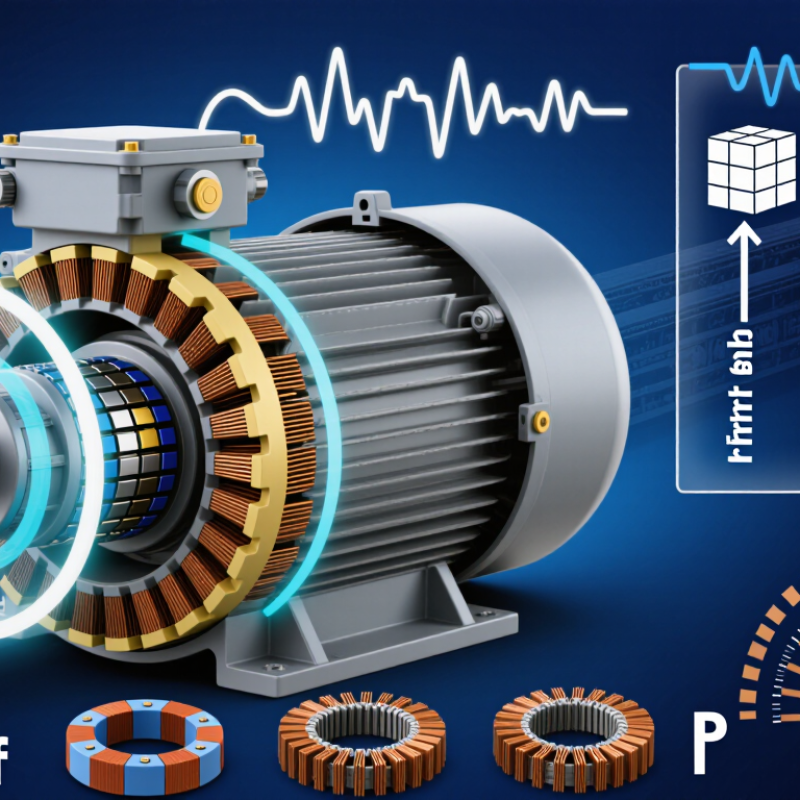
A Synchronous Motor converts electrical energy into steady mechanical rotation. Unlike an induction motor, its rotor turns in step with the stator’s rotating magnetic field. Stephen J. Chapman, a respected electrical-machinery author, states, “A synchronous motor is a motor that rotates at synchronous speed.” This simple definition hides an important engineering condition: the rotor must maintain magnetic synchronism after it reaches operating speed.

Inside the machine, three-phase AC flows through the stator windings. These windings create a rotating magnetic field. The rotor uses permanent magnets, DC excitation, or another magnetic arrangement to follow that field. Its speed depends on supply frequency and pole count, using the relationship Ns = 120f/P. A four-pole motor on a 50-hertz supply therefore runs at 1,500 revolutions per minute. Almost exactly. Small losses still exist.

Starting deserves attention. A conventional Synchronous Motor cannot normally start from zero speed by itself. Designers may add damper windings, use a variable-frequency drive, or connect an auxiliary starter. Once synchronized, the motor can operate with a leading power factor. This feature helps correct reactive power in factories filled with pumps, compressors, and conveyors.

The practical advantage is precise, constant speed. The weakness is less forgiving operation during overloads or voltage disturbances. That detail is often overlooked. Real installations also face heat, vibration, insulation aging, and imperfect alignment. Understanding these limits makes the machine easier to select, install, and maintain safely.
What Is a Synchronous Motor and How Does It Work?

What a Synchronous Motor Is and Where It Fits in Electric Machines

A synchronous motor is an AC machine whose rotor turns at the same speed as the stator’s rotating magnetic field. Its speed follows frequency and pole count, not ordinary load changes. For a two-pole motor on a 50 Hz supply, synchronous speed is 3,000 revolutions per minute. A four-pole design runs at 1,500 rpm. The rotor may use permanent magnets or a DC-fed field winding. Startup needs careful control because the rotor does not naturally accelerate from rest like an induction motor. Not quite.

Within the family of electric machines, it fits between constant-speed drive technology and electromechanical power conversion. The stator resembles that of many three-phase AC motors, while the rotor supplies a defined magnetic polarity. Once synchronized, the motor maintains speed with almost no slip. Its power factor can also be adjusted, allowing some designs to support reactive-power control. This makes synchronous motors useful in large pumps, compressors, and precision production equipment.

In field work, technicians check phase sequence, excitation, load angle, and temperature. A small wiring error can prevent synchronism. The textbook picture is clean, but real systems are less forgiving during acceleration. Control settings, inertia, and voltage dips all matter. I would not select this motor from speed alone; starting method, maintenance skill, and grid conditions deserve equal attention.

What Is a Synchronous Motor and How Does It Work?

A synchronous motor operates at the synchronous speed determined by the supply frequency and the number of stator poles. The chart shows the theoretical operating speed at 50 Hz and 60 Hz using the formula: Ns = 120f / P, where f is frequency in hertz and P is the number of poles.

The Main Parts and Magnetic Fields Inside a Synchronous Motor

A synchronous motor converts electrical energy into steady mechanical rotation. Its essential parts are the stator, rotor, shaft, bearings, and air gap. The stator surrounds the rotor and contains insulated copper windings placed in slots. When alternating current enters these windings, it creates a rotating magnetic field inside the motor.

The rotor carries its own magnetic field. This field may come from permanent magnets or direct-current excitation through a field winding. The rotor then locks onto the stator’s rotating field and turns at synchronous speed. There is no normal slip between the two fields. The shaft transfers this rotation to a pump, compressor, or other machine, while bearings keep the movement aligned. The narrow air gap matters greatly. A larger gap can weaken magnetic coupling and increase operating current.

The magnetic interaction is easier to picture with two invisible gears. The stator field pulls the rotor forward, while the rotor field resists sudden changes in position. During inspection, technicians often check winding insulation, bearing temperature, vibration, and the air gap. These details reveal problems before failure becomes obvious. Synchronous motors usually need special starting support, such as damper windings or an external drive. They do not simply start like ordinary induction motors. That point is often overlooked. In practice, textbook field diagrams can mislead because real fields spread, distort, and react to load changes. calc

How a Synchronous Motor Achieves Synchronous Speed Step by Step

What Is a Synchronous Motor and How Does It Work?

A synchronous motor follows the rotating magnetic field produced by its stator. Its rotor turns at exactly the field speed. The speed formula is Ns = 120f/P, where f is frequency and P is pole count. At 50 Hz, a four-pole motor reaches 1,500 revolutions per minute. This fixed relationship distinguishes it from an induction motor.

How a Synchronous Motor Achieves Synchronous Speed Step by Step

At startup, the rotor is stationary. It cannot instantly follow a rapidly rotating stator field. A damper cage or variable-frequency drive helps the rotor accelerate gradually. The drive raises frequency in small steps, creating a slower rotating field first. Once the rotor approaches the target speed, direct-current excitation strengthens its magnetic field. The rotor poles then align with the stator field and lock into step. No slip remains.

The International Energy Agency reported that motor-driven systems used about 46% of global electricity in its 2011 analysis. The U.S. Department of Energy also estimated that motors consumed roughly 69% of industrial electricity in its 2014 sourcebook. Efficient synchronization therefore matters beyond speed control. During commissioning, technicians check frequency, phase sequence, vibration, and load angle. A tachometer should confirm rated speed. The process sounds clean, but real loads fluctuate. An overloaded motor can lose synchronism, especially during sudden torque changes. That is the part many simplified explanations miss.

What Is a Synchronous Motor and How Does It Work? - How a Synchronous Motor Achieves Synchronous Speed Step by Step

Step Technical Dimension How It Works Key Relationship or Value Operational Result
1 Definition A synchronous motor is an AC motor whose rotor rotates at the same mechanical speed as the rotating magnetic field produced by the stator. Rotor speed = Synchronous speed The motor runs at a constant speed when the applied frequency and load remain within the operating limits.
2 Stator Construction The stator contains three-phase windings distributed around the air gap. When supplied with balanced three-phase AC, these windings create a rotating magnetic field. Rotating magnetic field The stator establishes the magnetic speed reference for the motor.
3 Rotor Excitation The rotor produces a magnetic field using either direct-current field excitation or permanent magnets. Field-excited rotors require a separate DC source and excitation system. Rotor field = DC or permanent magnet The rotor develops magnetic polarity that can interact with the stator field.
4 Synchronous-Speed Calculation Synchronous speed is determined by the supply frequency and the number of poles in the stator winding. Ns = 120f / P
r/min
At 60 Hz, a two-pole motor has a synchronous speed of 3,600 r/min; a four-pole motor has 1,800 r/min.
5 Initial Torque Condition When the rotor is stationary, the stator field sweeps past the rotor too quickly for the rotor poles to lock into synchronism immediately. Starting speed = 0 r/min A conventional synchronous motor is not inherently self-starting without an auxiliary starting method.
6 Starting Method Starting can be provided by damper bars, an auxiliary motor, or a variable-frequency drive that gradually increases the electrical frequency. f increases gradually with a drive The rotor accelerates while reducing the relative speed between the rotor field and the rotating stator field.
7 Acceleration A damper-equipped motor may begin like an induction motor. With a variable-frequency drive, the rotating magnetic field is accelerated in a controlled manner. Rotor speed approaches Ns The rotor reaches a speed close enough to the rotating field for magnetic locking to occur.
8 Pull-In and Magnetic Locking Once the rotor poles align with the rotating stator field at the correct relative position, the magnetic attraction and repulsion forces lock the rotor to the field. Nr = Ns The rotor reaches synchronous speed and continues rotating in step with the stator field.
9 Slip in Steady Operation Under stable synchronous operation, the average speed difference between the rotor and rotating magnetic field is zero. s = (Ns − Nr) / Ns = 0 Speed does not decrease as load is added in the same way it does in an induction motor; the torque angle changes instead.
10 Load and Torque Angle As mechanical load increases, the rotor magnetic axis shifts by a larger electrical angle behind the stator field while remaining synchronized. More load → larger torque angle The motor supplies additional electromagnetic torque without a sustained change in average speed.
11 Loss of Synchronism If the load exceeds the motor's pull-out torque, or if the supply conditions are unsuitable, the rotor can no longer remain locked to the rotating field. Load torque > pull-out torque The motor falls out of synchronism and may stop, oscillate, or draw excessive current.
12 Power Factor Control In a field-excited synchronous motor, changing the rotor field current changes the reactive power exchanged with the AC system. Under-, unity-, or over-excitation The motor can operate at a lagging, approximately unity, or leading power factor, subject to its design limits.
13 Speed Regulation For a fixed number of poles, the motor speed is directly determined by the electrical supply frequency. Ns ∝ f A frequency converter can provide precise speed control by changing the applied frequency.
14 Typical Applications Constant-speed and high-efficiency operation makes synchronous motors suitable for large pumps, compressors, fans, industrial drives, and power-factor correction duties. Constant speed and controllable reactive power The motor is selected when accurate speed, high efficiency, or reactive-power support is important.

Different Starting Methods and Operating Modes of Synchronous Motors

What Is a Synchronous Motor and How Does It Work?

Different Starting Methods and Operating Modes of Synchronous Motors

A synchronous motor runs when its rotor locks to the rotating magnetic field. Its speed follows supply frequency, not changing load speed. For a 50 Hz, four-pole motor, synchronous speed is 1,500 revolutions per minute. The rotor cannot normally start alone because it has no initial torque at standstill. That detail is easy to overlook.

Engineers use several starting methods. A damper-winding start makes the motor behave like an induction motor during acceleration. When it approaches synchronous speed, direct current excites the rotor field and pulls it into step. A variable-frequency drive starts at low frequency, then increases frequency smoothly. This method limits inrush current and reduces mechanical shock.

A pony motor can also accelerate large machines before field excitation begins. It remains useful, but its extra equipment increases maintenance.

Operating mode depends strongly on rotor excitation. With normal excitation, the motor operates near unity power factor and mainly supplies mechanical output. Overexcitation makes it draw leading current, allowing the motor to correct reactive power in an industrial bus. Underexcitation causes lagging current and may increase system losses. In condenser mode, the shaft carries little mechanical load, but the machine supports voltage and power factor.

The International Energy Agency estimates motor systems consume about 45% of global electricity. U.S. Department of Energy assessments also place motor-driven equipment near 70% of industrial electricity use. These figures show why starting current and excitation control matter. In practice, operators still misjudge thermal stress during repeated starts. A technically correct design can perform poorly without measured acceleration time, load inertia, and field-current records.

Key Applications, Benefits, and Limitations of Synchronous Motors

What Is a Synchronous Motor and How Does It Work?

Key Applications, Benefits, and Limitations of Synchronous Motors

A synchronous motor converts electrical energy into mechanical rotation. Its rotor turns at the same speed as the rotating magnetic field. There is no normal operating slip. An alternating-current supply creates the stator’s rotating field. The rotor follows this field through permanent magnets or direct-current excitation. This relationship gives the motor precise speed control under steady loads.

Synchronous motors suit equipment that demands stable speed. Industrial pumps, compressors, conveyors, and large fans often use them. Power-factor correction is another important application. An overexcited motor can supply reactive power and improve electrical efficiency. In practical installations, this may reduce losses across a facility’s distribution system. The benefit is measurable.

Still, the design is not automatically superior. Starting can require special controls, auxiliary windings, or an external drive. The motor may also lose synchronism when a sudden load exceeds its pull-out torque. Protection settings must therefore match the machine and operating conditions. Maintenance teams should inspect bearings, insulation, cooling paths, and excitation systems. Installation quality matters greatly. A theoretical efficiency figure can disappoint in a dusty room, under poor ventilation, or with frequent starts. That limitation deserves more attention. Cost, control complexity, and skilled commissioning can outweigh energy savings in smaller applications. Engineers should compare the complete lifecycle, not only the nameplate efficiency.

FAQS

What is a synchronous motor?

It is an alternating-current motor whose rotor matches the stator’s rotating magnetic field. The rotor turns at a fixed speed. It has no normal operating slip.

How is synchronous speed calculated?

Use the formula Ns = 120f/P. Here, f means frequency, and P means the number of poles. At 50 hertz, a four-pole motor runs at 1,500 revolutions per minute.

Why cannot a synchronous motor usually start by itself?

A stationary rotor cannot immediately follow a fast rotating magnetic field. It needs help during acceleration. This small detail matters.

How does a damper-winding start work?

Damper windings let the motor start like an induction motor. The rotor accelerates toward synchronous speed. Direct-current excitation then pulls the rotor into alignment.

How does a variable-frequency drive help during startup?

It begins with a low-frequency rotating field. The drive raises frequency gradually in small steps. This reduces starting current and mechanical shock.

What happens when the rotor reaches synchronous speed?

The rotor poles align with the stator field. The magnetic fields lock together. The rotor then turns at synchronous speed without normal slip.

What are the main operating modes?

Normal excitation supports mechanical output near unity power factor. Overexcitation produces leading current and can support reactive power. Underexcitation produces lagging current and may increase system losses. In condenser mode, the shaft carries little mechanical load.

Where are synchronous motors commonly used?

They suit pumps, compressors, conveyors, and large fans. These machines often need stable speed under steady loads. They can also improve power factor across an industrial electrical system.

What can cause a synchronous motor to lose synchronism?

A sudden load increase can exceed the motor’s pull-out torque. The rotor may fall out of step. Real loads fluctuate, so simple explanations can be misleading.

What should technicians check during commissioning?

They should check frequency, phase sequence, vibration, load angle, and field current. A tachometer should confirm the rated speed. Acceleration time and load inertia also deserve attention. A perfect nameplate figure proves little in a dusty room.

Conclusion

A Synchronous Motor is an AC electric machine designed to rotate at a constant speed that matches the frequency of its power supply. Unlike induction motors, it uses a rotating magnetic field produced by the stator and a magnetic field created by the rotor, allowing both fields to lock together during normal operation. Its main parts include the stator windings, rotor, excitation system, shaft, and supporting mechanical structure. Once synchronized, the rotor turns at synchronous speed with little or no slip.

Synchronous motors may require special starting methods, such as an auxiliary motor, damper windings, or electronic control, because they cannot normally start by themselves from a standstill. They can operate with different power-factor conditions, making them useful for industrial drives, compressors, pumps, and power-factor correction. Their main advantages include constant speed, high efficiency, and controllable reactive power. However, they generally involve greater construction complexity, higher initial cost, and more demanding starting and control requirements than simpler motor types.

Amelia

Amelia

Amelia is a seasoned marketing professional with a wealth of expertise in our company’s core offerings. With an unwavering passion for driving growth and innovation, she plays a pivotal role in shaping our marketing strategies and enhancing brand visibility. A key aspect of her responsibilities......